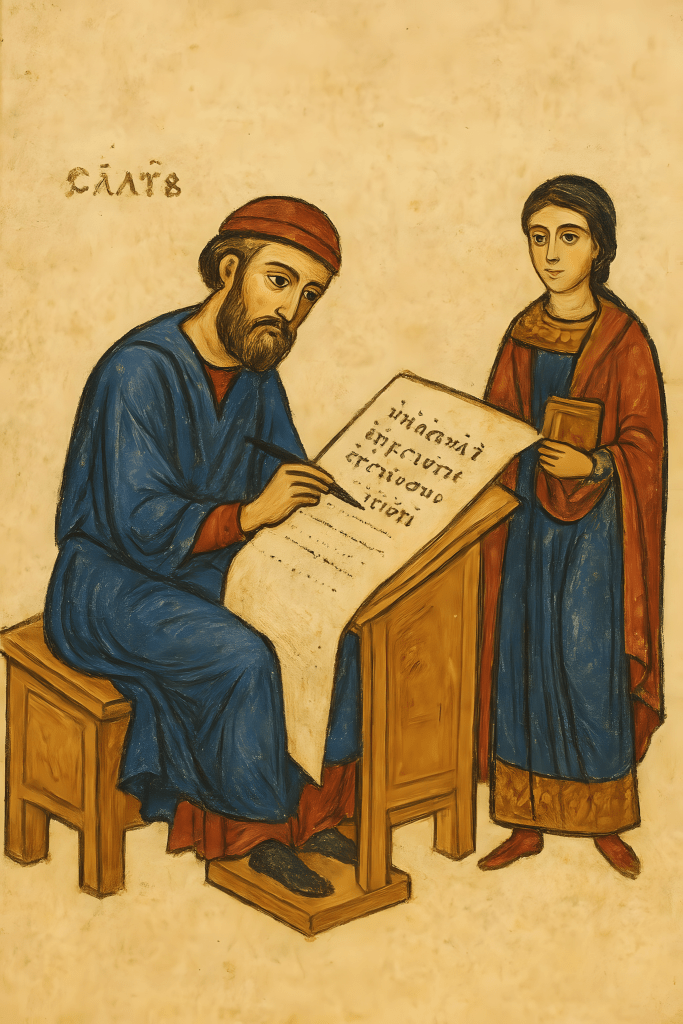
The high Literacy in the eastern Roman Empire explained
The surviving part of the Roman Empire in the East was significantly more literate than most other Christian societies of the same periods, especially compared with Western Europe before the 12th century. Not all “Byzantines” could read, but literacy was far more widespread, continuous, and socially embedded. Here are some of the reasons:
동로마 제국의 높은 문해력
동로마 제국의 현존 지역은 동시대 대부분의 다른 기독교 사회보다 문해력이 훨씬 높았으며, 특히 12세기 이전 서유럽과 비교했을 때 더욱 그러했다.
모든 “비잔틴인”이 글을 읽을 수 있었던 것은 아니었지만, 문해력은 훨씬 더 광범위하고 지속적이며 사회적으로 뿌리내리고 있었다.
그 이유는 다음과 같다.
- 로마 행정의 생존
비잔틴 제국은 많은 문해력을 갖춘 관리, 공증인, 세무 공무원, 판사를 요구한 후기 로마 관료제를 유지했다. 이로 인해 제국 전역에 걸쳐 지속적이고 실질적인 문해력의 필요성이 대두되었다. - 안정적인 학교와 고등 교육
콘스탄티노플은 제국 학교를 유지했고, 425년부터는 대학 수준의 교육 기관을 지속적으로 운영했다. 문법, 수사학, 철학, 법학을 수세기 동안 가르쳐 숙련된 공무원과 교육받은 엘리트를 배출했다. - 글을 읽고 쓸 줄 아는 성직자와 수도원 필사본
본당 사제들은 전례를 거행하기 위해 기본적인 문해력이 필요했고, 수도원, 특히 스투디오논과 같은 곳에서는 엄청난 양의 필사본이 제작되었다. 이로 인해 읽기와 쓰기는 종교 생활의 핵심이 되었다. - Survival of Roman administration
The Byzantine state kept the late Roman bureaucracy, which demanded large numbers of literate officials, notaries, tax clerks, and judges. This ensured a constant, practical need for literacy across the empire. - Stable schools and higher learning
Constantinople maintained imperial schools and, from 425, a continuously operating university-level institution. Grammar, rhetoric, philosophy, and law were taught for centuries, producing trained civil servants and educated elites. - A literate clergy and monastic scriptoria
Parish priests generally needed basic literacy to perform the liturgy, and monasteries—especially places like the Studion—produced vast numbers of manuscripts. This kept reading and writing central to religious life. - Greek as a unifying literary language
The empire used a single, ancient language with a well-developed alphabet and an enormous classical heritage. Children often learned basic reading at home from psalters and simple grammars. - A culture of paideia
Education was a marker of identity. Byzantine elites saw themselves as heirs of Hellenic learning and Roman governance, creating strong incentives to cultivate literacy and rhetoric.
The result
While literacy was never universal, it was much deeper and broader than in most contemporary Christian societies, supported by the state, church, cities, and the prestige of Greek. - 통합적인 문학 언어로서의 그리스어
제국은 잘 발달된 알파벳과 방대한 고전 유산을 지닌 단일 고대 언어를 사용했다. 아이들은 종종 집에서 시편과 간단한 문법을 통해 기본적인 읽기를 배웠다.
- 파이데이아 문화
교육은 정체성의 지표였다. 비잔틴 엘리트들은 스스로 헬레니즘 학문과 로마 통치의 계승자로 여겼고, 이는 문해력과 수사학을 함양하도록 강력한 동기를 부여했다.
결과
문해력이 보편적이었던 적은 없지만, 국가, 교회, 도시, 그리고 그리스어의 명성에 힘입어 대부분의 현대 기독교 사회보다 훨씬 더 깊고 광범위했다.
Bibliography
For Byzantine literacy and education, see Robert Browning, The Byzantines (Cambridge, 1992); Judith Herrin, Byzantium: The Surprising Life of a Medieval Empire (London, 2007); Cyril Mango, Byzantine Literature: The Word of God and the Words of Men (Cambridge, 1978); Nigel Wilson, Scholars of Byzantium (Cambridge, 1983); and Paul Lemerle, Le premier humanisme byzantin (Paris, 1971). On administrative and monastic foundations of literacy, consult N. Oikonomides, Byzantine State and Society (Brookfield, 1991) and the entries “Education” and “Literacy” in the Oxford Dictionary of Byzantium (ed. A. Kazhdan, Oxford, 1991). For comparison with the medieval West, see Chris Wickham, The Inheritance of Rome (London, 2009) and Rosamond McKitterick, The Carolingians and the Written Word (Cambridge, 1989).
 HeriTrip.com
댓글 남기기