
From the Porta Marina gate, Via Marina climbs up steeply towards the Forum which was the main square in Pompeii and was reserved exclusively for pedestrians as all vehicles were forbidden entry. This was the very heart of Pompeii’s daily life and housed the most important municipal, religious and commercial buildings in the town, in addition to being the intersection of the main streets.
Around the Forum we find the town’s most important temples, the public offices where the administrative authorities governed the town, as well as legal offices and a few markets. There were no private houses at all.
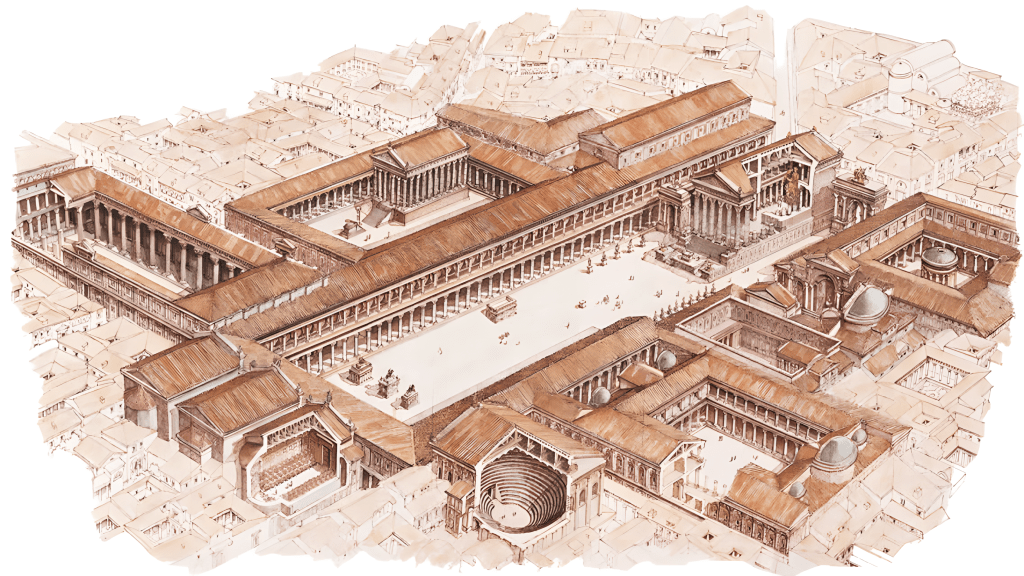
Before illustrating each of these it is worth describing the actual space the Forum occupies. The forum runs north-south for 142 metres and is 38 metres wide. As it had always been the seat of political and religious power, its buildings were frequently modified to reflect new construction techniques or fashions, cultural and political influences and also changes in cult worship.
The architecture in the Forum was characterized by a colonnade on three sides while the fourth side provided an uninterrupted view of the Temple of Jupiter. It was paved with travertine stone slabs, only a few traces of which now remain. Originally the colonnade consisted of a double order of Nuceria tuff-stone columns with Doric columns in the lower order and Ionic columns in the upper one. A few remains of these can be seen in the southern part of the Forum, while the western part preserves traces of the stairs leading up to the open gallery.
The travertine stone colonnade was started in the Julio-Claudian age but was never completed. The bases of numerous statues are visible in the Forum. On these stood equestrian statues of emperors and influential citizens of the town and include the Suggestum, which was used for speaking to the townspeople. However, not a single statue was ever found.
After the earthquake of 62 A.D. the Forum became a huge building site to repair the damage it had suffered and all the statues were transferred elsewhere. Moreover, it is thought that the Forum, like other parts of the town, was stripped of its marble and even its floor immediately after the eruption of 79 A.D.
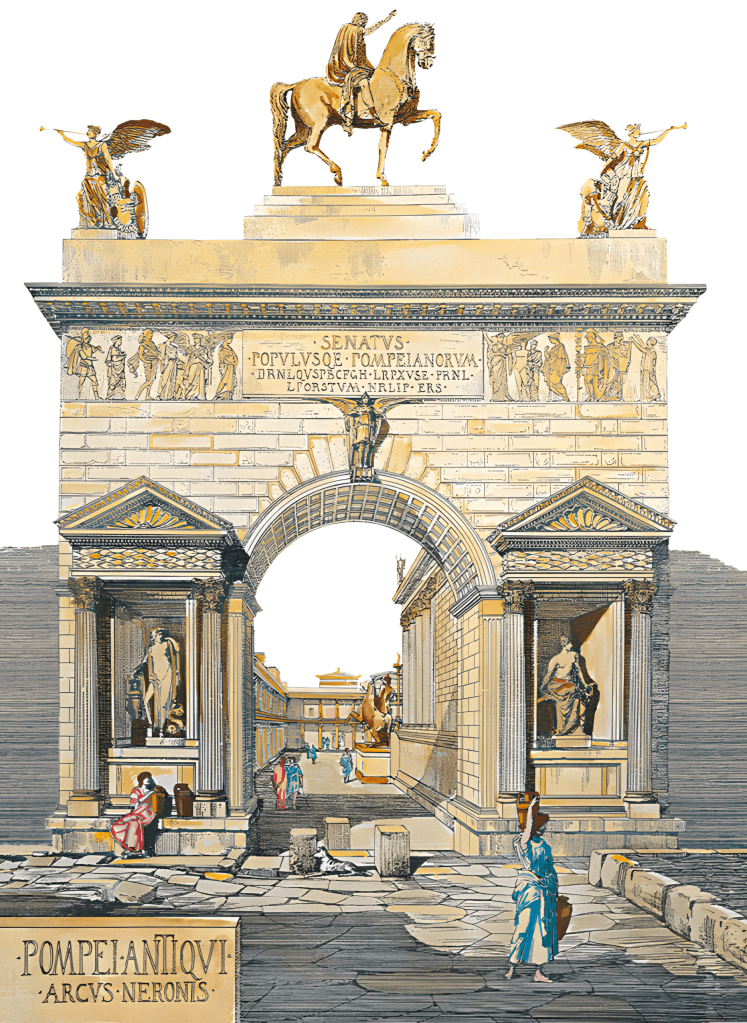
On either side of the Temple of Jupiter the Forum was closed by two arches topped with equestrian statues. The arch on the right-hand side is thought to be dedicated to Nero.
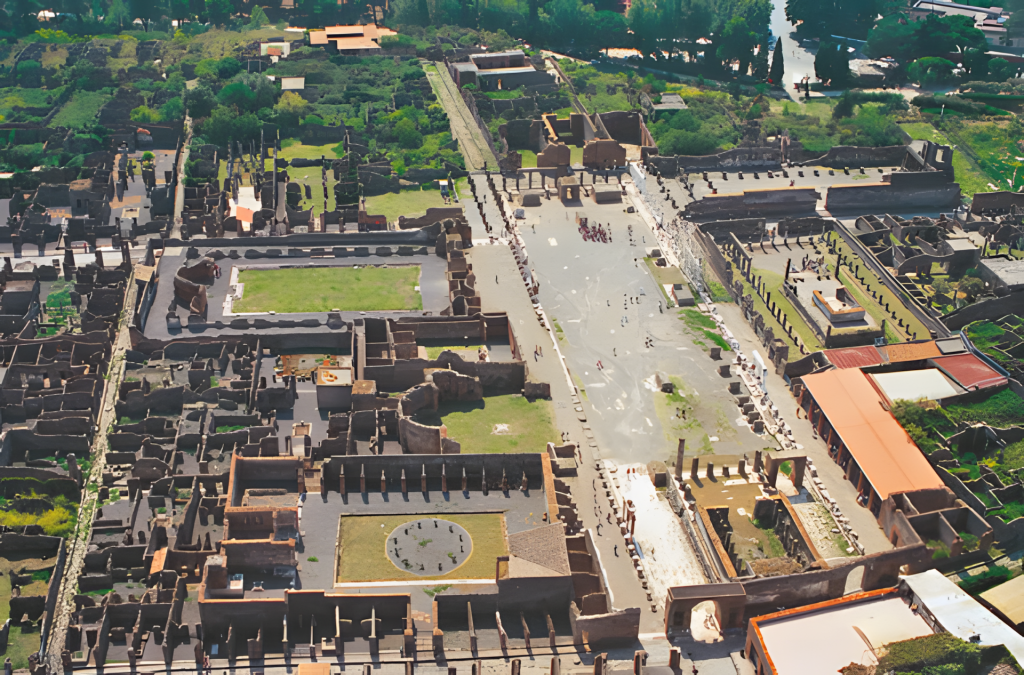
포르타 마리나Porta Marina 문에서 비아 마리나Via Marina는 폼페이 중심 광장인 포럼Forum을 향해 가파른 경사를 이룬다.
포럼은 모든 수레 진입이 금지되어 보행자만 출입할 수 있었다.
폼페이 일상생활 중심이었으며, 주요 도로들이 교차하는 지점일 뿐만 아니라 마을에서 가장 중요한 시립, 종교, 상업 건물들이 자리 잡고 있었다.
포럼 주변에는 마을에서 가장 중요한 사원, 행정 당국이 마을을 통치하던 관공서, 법률 사무소, 그리고 몇몇 시장이 있다. 개인 주택은 전혀 없었다.
각각의 모습을 보여주기 전에 포럼이 차지하는 실제 공간을 설명하는 것이 좋다.
포럼은 남북으로 142미터, 너비 38미터다.
항상 정치 및 종교 권력 중심지였던 만큼 새로운 건축 기법이나 유행, 문화적, 정치적 영향, 그리고 종교적 신앙의 변화를 반영하기 위해 건물들이 자주 개조되었다.
포럼의 건축 양식은 삼면에 주랑colonnade이 있는 점이 특징이며, 네 번째 면은 유피테르 신전Temple of Jupiter 탁 트인 전망을 제공한다. 트라버틴 석판travertine stone slabs으로 포장되어 있었는데, 현재는 그 흔적이 거의 남아 있지 않다.
원래 주랑은 누케리아 응회암 기둥Nuceria tuff-stone columns이 두 줄로 배열되어 있었는데, 아래쪽에는 도리아식 기둥Doric columns, 위쪽에는 이오니아식 기둥Ionic columns이 있었다.
포럼 남쪽 부분에서는 이러한 기둥 흔적을 볼 수 있으며, 서쪽 부분에는 야외 갤러리로 이어지는 계단 흔적이 남아 있다.
트라버틴 석조 주랑은 율리우스-클라우디우스 시대Julio-Claudian age에 착공되었지만 완공되지는 않았다.
포럼에는 수많은 조각상 기단이 남아 있다.
이 조각상들 위에는 황제와 도시 유력 인사들 기마상이 서 있었고, 시민들에게 연설하는 데 사용된 수게스툼Suggestum도 있었다. 그러나 단 하나 조각상도 발견되지 않았다.
서기 62년 지진 이후, 포럼은 피해를 복구하기 위한 거대한 건설 현장이 되었고 모든 조각상은 다른 곳으로 옮겨졌다.
게다가, 도시 다른 지역과 마찬가지로 포럼 역시 서기 79년 화산 폭발 직후 대리석과 바닥까지 벗겨진 것으로 추정된다.
유피테르 신전 양쪽에는 기마상이 얹힌 두 개 아치가 포럼을 막고 있었다.
오른쪽 아치는 네로에게 봉헌한 것으로 추정된다.
 HeriTrip.com
댓글 남기기