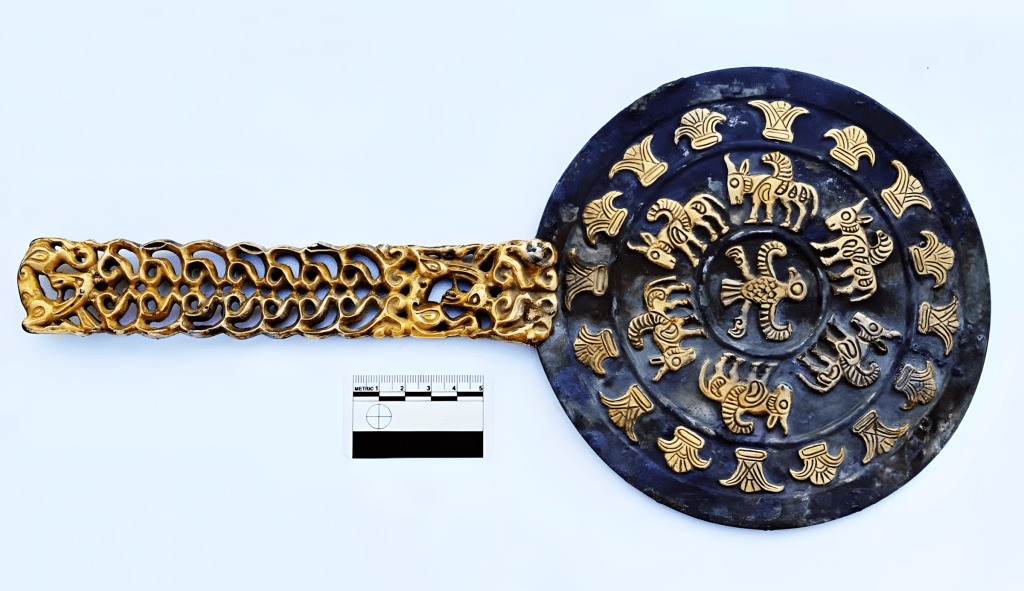
유라시아 스텝의 철기 시대 고분에서 발굴된 가장 흥미로운 유물 중 하나는 러시아 남부 우랄 지역 오렌부르크Orenburg 인근 필리포프카 쿠르간 콤플렉스Filippovka kurgan complex에서 발견된 이 은색 의례용 거울silver-colored ritual mirror이다.
기원전 5세기에서 4세기경 제작으로 추정되는 이 거울은 전통적으로 사르마티아인Sarmatians과 관련된 문화적 맥락에 속하지만, 그 예술적 표현은 스텝 유목민과 페르시아 영향을 받은 스키토-시베리아 동물 양식Scytho-Siberian animal style을 더 폭넓게 반영한다.
이 거울은 주석 함량이 높은 청동high-tin bronze으로 주조했는데, 이 합금은 옅은 은빛 외관과 높은 반사율 때문에 “백동white bronze”이라고도 일컫는다.
실용적인 청동과는 달리, 이 소재는 부서지기 쉽고 가공하기 어려워 이 거울이 일상생활용으로 제작된 것이 아님을 시사한다.
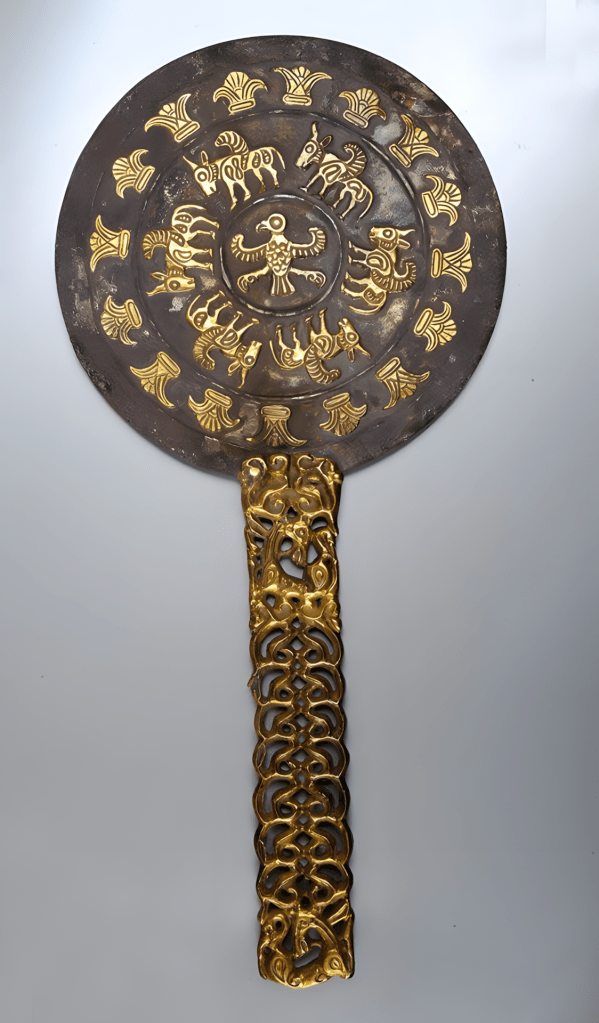
화려하게 장식하고 금으로 도금한 손잡이는 이 거울의 위엄과 의례적 기능을 더욱 강조한다.
거울의 원형 면은 동물 형상으로 빽빽하게 장식하는데, 양식화한 동물들이 리드미컬한 방사형 패턴으로 배열되어 있다.
이러한 이미지는 스텝 지역 우주관에서 흔히 볼 수 있는 특징으로, 동물들은 종종 토템적 존재나 우주 구조와 연결된 우주적 힘으로 여겨졌다.
구성 중심에는 많은 학자가 헤로도토스와 같은 고전 문헌에 등장하는 스키타이의 화로와 신성한 불의 여신 타비티Tabiti로 해석하는 중요한 인물이 나타난다.
이러한 해석에 대해서는 여전히 논쟁이 있지만, 중앙에 배치된 것은 단순한 장식이 아니라 우주론적 또는 신성한 의미를 강하게 시사한다.
이 거울의 가장 주목할 만한 특징 중 하나는 재질적 특성이다.
이와 같은 고함량 주석 청동 물체는 두드리면 종소리와 같은 공명음을 내는 것으로 알려져 있다.
이러한 음향적 특성은 거울이 의식이나 샤머니즘적 행위에서 소리와 반사를 결합한 의례 도구로 사용되었을 가능성을 시사한다.
다른 고대 문화에서도 이와 유사한 다감각적 효과가 기록되어 있으며, 이는 그러한 물건들이 단순히 전시된 것이 아니라 의식 중에 활성화했다는 생각을 뒷받침한다.
철기 시대 스텝 지역에서 가장 풍부한 엘리트 공동묘지 중 하나인 필리포프카 매장 맥락은 이러한 해석을 뒷받침한다.
고위층 무덤에서는 거울이 시신 근처에 놓이는 것이 일반적이었는데 이는 영혼, 우주의 질서 또는 사후 세계와 상징적인 연관성을 시사한다.
이러한 물건을 소유하는 것은 엘리트 지위와 종교적 권위를 의미하며, 숙련된 금속 세공인과 장거리 교역망에 대한 접근성을 반영하는 것일 수 있다.
A Ritual Mirror from the Eurasian Steppes: The Filippovka Sarmatian Mirror
Among the most intriguing objects recovered from the Iron Age burial mounds of the Eurasian steppes is a silver-colored ritual mirror discovered at the Filippovka kurgan complex near Orenburg in Russia’s southern Ural region.
Dating to the 5th–4th century BCE, this object belongs to the cultural horizon traditionally associated with the Sarmatians, though its artistic language reflects a broader Scytho-Siberian animal style shaped by steppe nomadic and Persian influences.
The mirror was cast from high-tin bronze, an alloy sometimes referred to as “white bronze” due to its pale, silvery appearance and high reflectivity. Unlike utilitarian bronze, this material is brittle and difficult to work, indicating that the mirror was never intended for everyday use. Its openwork handle, richly decorated and gilded with gold, further emphasizes its prestige and ceremonial function.
The circular face of the mirror is densely ornamented with zoomorphic figures—stylized animals arranged in a rhythmic, radial pattern. Such imagery is characteristic of steppe cosmology, where animals often functioned as totemic beings or cosmic forces linked to the structure of the universe.
At the center of the composition appears a prominent figure that many scholars interpret as Tabiti, the Scythian goddess of the hearth and sacred fire, known from classical sources such as Herodotus. While this identification remains debated, the central placement strongly suggests a cosmological or divine focus, rather than mere decoration.
One of the mirror’s most remarkable features lies in its material properties. High-tin bronze objects of this type are known to produce resonant, bell-like tones when struck. This acoustic quality suggests that the mirror may have functioned as a ritual instrument, combining sound and reflection during ceremonial or shamanic practices.
Similar multisensory effects are documented in other ancient cultures, reinforcing the idea that such objects were activated during rites rather than passively displayed.
The burial context at Filippovka—one of the richest elite cemetery complexes of the Iron Age steppe—supports this interpretation. Mirrors were typically placed near the body in high-status graves, implying symbolic associations with the soul, cosmic order, or the afterlife.
Ownership of such an object would have signified elite status and possibly religious authority, reflecting access to skilled metalworkers and long-distance exchange networks.
 HeriTrip.com
댓글 남기기