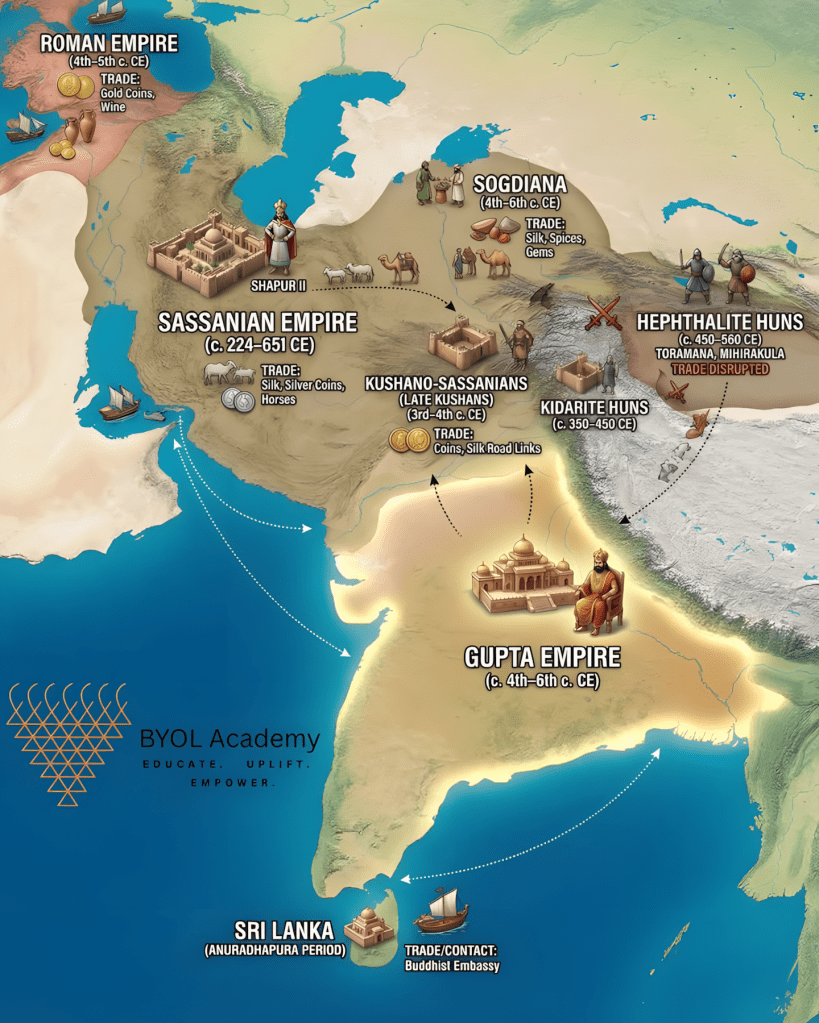
굽타 제국과 동시대에 존재한 중동, 북서부 및 중앙아시아 지역 왕국들
북서부 지역에서는 후기 쿠샨 왕조가 서기 3세기에서 4세기 사이에 아프가니스탄, 카슈미르, 서부 펀자브 지역을 통치하며 활동했다.
쿠샨 왕조 세력은 전성기에서 쇠퇴했지만, 초기 굽타 왕조와는 동시대 세력이었다.
이 지역들은 실크로드와 연결된 교역로에 위치해 있어 인도와 중앙아시아 간 무역, 특히 비단, 말, 화폐 무역이 활발했다.
인도 북서부와 이란에서는 사산 왕조(서기 3세기~7세기)가 주요 동시대 세력이었다.
샤푸르 2세와 같은 통치자들은 굽타 왕조와 동시대 인물이었다.
사산 왕조의 영향력은 신드와 인도의 북서부 국경 지역까지 미쳤다.
중앙아시아에서는 키다리트 훈족이 서기 4세기에서 5세기 사이에 박트리아와 아프가니스탄 지역을 점령하며 활동했다.
그들은 굽타 제국 북서부 국경에 압력을 가했다.
제한적인 무역 접촉 외에도, 그들의 존재는 더 넓은 지역에 말을 이용한 군사 전통을 전파했다.
서기 5세기경, 알콘 훈족은 강력한 세력으로 부상했다.
그들의 통치자 토라마나와 미히라쿨라는 후대 굽타 왕조와 동시대 인물이었다.
중앙아시아 서쪽에서는 로마와 동로마 제국(비잔틴 제국)이 굽타 경제와 간접적으로 연결되어 있었다.
인도의 향신료, 보석, 면직물은 사산 왕조와 중앙아시아 국가들을 중개자로 삼아 이란과 중앙아시아를 거쳐 서방 시장에 도달했다.
전반으로 굽타 제국과 동시대 북서부 및 중앙아시아 왕국들의 관계는 단순히 갈등에 그치지 않았다.
무역 네트워크, 화폐 유통, 문화 교류를 통해 관계가 지속되었으며, 이는 굽타 시대에 인도를 더 넓은 유라시아 체제에 통합하는 데 기여했다.
Kingdoms in Middle east, North-western and Central Asian regions contemporary to Gupta Empire –
In the north-western regions, the Later Kushans were active during the 3rd–4th Centuries CE, ruling parts of Afghanistan, Kashmir, and western Punjab. Although Kushan power had declined from its peak, they remained contemporaries of the early Guptas. These regions lay along routes connected to the Silk Route, which facilitated trade between India and Central Asia, especially in silk, horses, and coinage.
In north-western India and Iran, the Sassanian Empire (3rd–7th Centuries CE) was a major contemporary power. Rulers such as Shapur II were contemporaneous with the Guptas. Sassanian influence extended toward Sindh and the north-western frontiers of India.
In Central Asia, the Kidarite Huns were active during the 4th–5th Centuries CE, occupying regions of Bactria and Afghanistan. They exerted pressure on the north-western frontiers of the Gupta Empire. Alongside limited trade contacts, their presence also introduced horse-based military traditions into the broader region.
During 5th Century CE, the Alchon Huns emerged as a powerful force. Their rulers Toramana and Mihirakula were contemporaries of the later Guptas.
To the west of Central Asia, the Roman and Eastern Roman (Byzantine) world was indirectly connected to the Gupta economy. Spices, precious stones, and cotton textiles from India reached western markets through Iran and Central Asia, with the Sassanians and Central Asian polities acting as intermediaries.
Overall, the Gupta Empire’s relations with contemporary north-western and Central Asian kingdoms were not limited to conflict. They were sustained through trade networks, coin circulation, and cultural exchanges, which integrated India into a wider Eurasian system during the Gupta period.
 HeriTrip.com
댓글 남기기