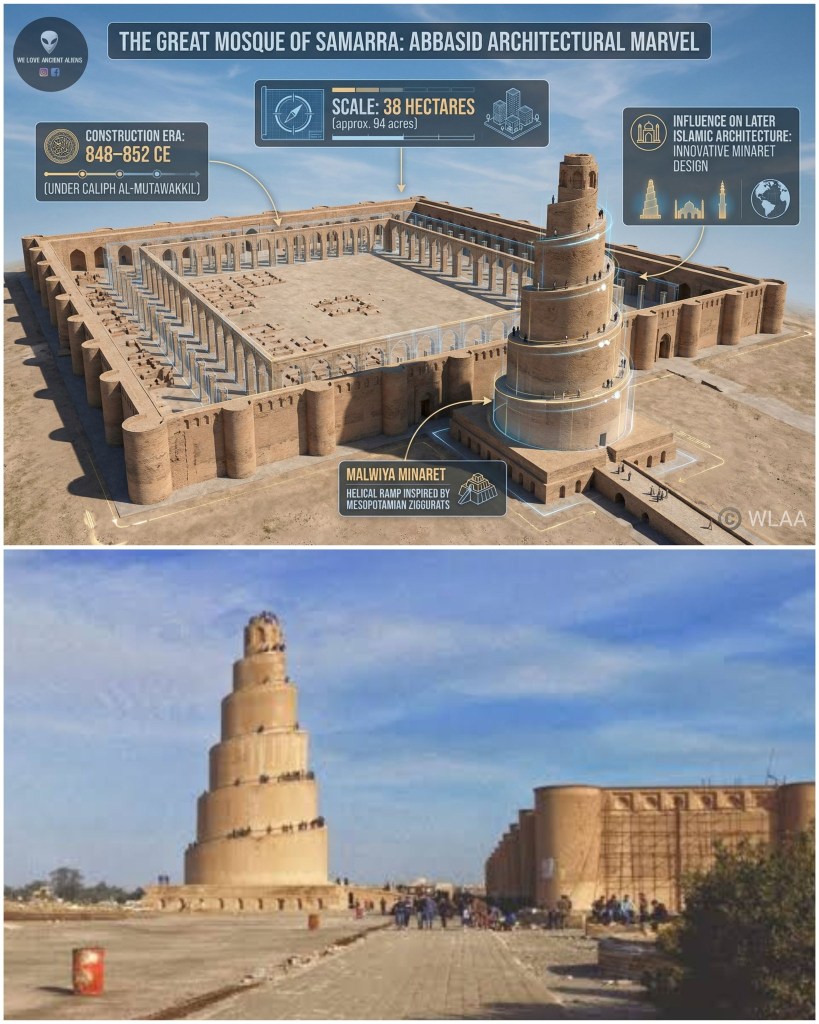
The Great Mosque of Samarra is an immense Abbasid-era congregational mosque constructed in 848–852 CE under the caliph al-Mutawakkil, located in the historic city of Samarra, Iraq.
Conceived as the largest mosque of its time, the complex covers roughly 38 hectares and is defined by vast baked-brick walls, arcaded prayer halls, and a monumental open courtyard designed to accommodate tens of thousands of worshippers.
Its most distinctive feature is the Malwiya Minaret, a towering spiral structure rising about 52 metres, whose ascending ramp coils around a solid core and may have drawn inspiration from ancient Mesopotamian ziggurats.
The mosque’s scale and layout reflect the political power and architectural ambition of the Abbasid Caliphate at its height, while its innovative minaret form influenced later Islamic architecture.
Although much of the structure lies in ruins, the Great Mosque of Samarra remains one of the most important and visually striking monuments of early Islamic monumental design…
사마라 대모스크Great Mosque of Samarra는 이라크 사마라Samarra의 역사 도시에 위치하며, 칼리프 알 무타와킬al-Mutawakkil 통치 시절인 848년부터 852년 사이에 건설된 거대한 아바스 왕조 시대 회중 모스크congregational mosque다.
당시 최대 규모 모스크로 설계된 이 복합 단지는 약 38헥타르에 달하는 면적을 차지하며, 거대한 벽돌 벽, 아케이드가 있는 기도실arcaded prayer halls, 그리고 수만 명 예배자를 수용하도록 설계된 웅장한 안뜰open courtyard이 특징이다.
가장 눈에 띄는 특징은 말위야 미나레트Malwiya Minaret인데, 높이 52미터에 달하는 이 나선형 구조물은 견고한 중심부를 중심으로 나선형으로 뻗어 올라가는 경사로를 지니며, 고대 메소포타미아의 지구라트ziggurats에서 영감을 받았을 가능성이 있다.
모스크 규모와 구조는 아바스 칼리프Abbasid Caliphate 왕조 전성기의 정치적 권력과 건축적 야망을 반영하며, 혁신적인 미나레트 형태는 후대 이슬람 건축에 영향을 미쳤다.
비록 구조물 대부분이 폐허가 되었지만, 사마라 대모스크는 초기 이슬람 건축 양식의 가장 중요하고 시각적으로 인상적인 기념물 중 하나로 남아 있다.
 HeriTrip.com
댓글 남기기