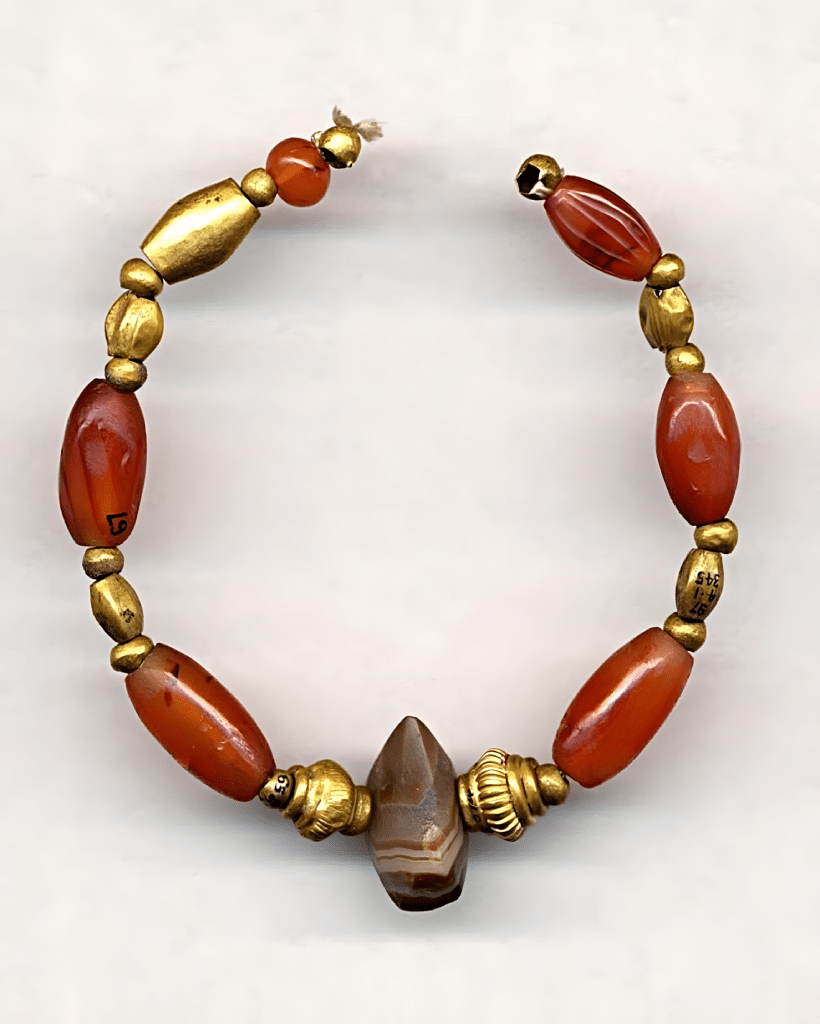
이들 황금 카르넬리아 그리고 마노 구슬 세트는 키프러스 엔코미 마을에서 발견되었다.
이 구슬들은 기원전 1550년에서 1050년 사이에 착용했는데, 당시 엔코미Enkomi는 사실상 세계 구리 산업 중심지였으며 이집트, 그리스, 하티Hatti, 미탄니Mitanni와 중요한 외교 및 무역 관계를 맺고 있었다.
엔코미의 중요성은 이 도시가 트로오도스Troodos 산맥의 광산과 가까웠기 때문인데, 이곳에서는 구리를 제련하여 마치 동물의 가죽을 늘린 듯한 모양의 커다란 덩어리인 “소가죽 주괴oxhide ingots”를 만들었다.
이러한 모양은 운반용 동물의 등에 싣기 편리하도록 설계되었다.
이 주괴는 사르디니아, 크레타, 펠로폰네소스, 시칠리아, 터키의 고대 하투샤Hattusa, 이집트, 불가리아뿐만 아니라 침몰한 두 척 배 내부에서도 발견되었다.
이 구슬들은 1896년 엠마 투르너 터너Miss Emma Tourner Turner라는 여성이 그리스, 로마, 이집트 또는 성서 유적과 관련된 유적의 발굴, 탐사 또는 조사를 위해 영국 박물관에 남긴 2,000파운드의 유산으로 자금을 지원받은 탐험대가 발견했다.
They were worn between 1550-1050BCE, when Enkomi was essentially the copper capital of the world, engaged in significant diplomatic and trade relations with Egypt, Greece, Hatti, and Mitanni. Its importance was due to the city’s proximity to the Troodos mountain mines, where copper was smelted into large slabs shaped like stretched animal hides called “oxhide ingots”—a design which facilitated their transport of the back of pack animals. These ingots have been found in Sardinia, Crete, the Peloponnese, Sicily, ancient Hattusa in Turkey, Egypt, and Bulgaria, as well as in the bowels of two sunken ships.
The beads were found in 1896 by an expedition funded with a legacy of 2.000 pounds that a certain Miss Emma Tourner Turner left to the British Museum for the purpose of excavation, exploration or survey of sites related to Greece, Rome, Egypt or the Biblical Antiquities.
 HeriTrip.com
댓글 남기기