IGNEOUS PETROLOGY: SPATTER CONES (MINI VOLCANIC CONES MADE OF MOLTEN BLOBS OF LAVA)
INTRODUCTION
Spatter cones are small volcanic landforms that form around eruptive vents when blobs of molten lava are ejected during volcanic activity and accumulate close to their point of emission.
They are part of the broader study of igneous petrology, which examines the origin, classification, and evolution of igneous rocks and volcanic structures.
Unlike large stratovolcanoes or shield volcanoes, spatter cones are miniature in scale, yet they provide valuable insights into the dynamics of volcanic eruptions, lava chemistry, and surface geological processes.
FORMATION PROCESS
Spatter cones develop primarily during low to moderate explosive volcanic activity.
When magma rich in gases ascends through a vent, it fragments into molten blobs of lava called spatters.
These semi-molten fragments land around the vent while still hot and sticky, allowing them to weld together upon impact.
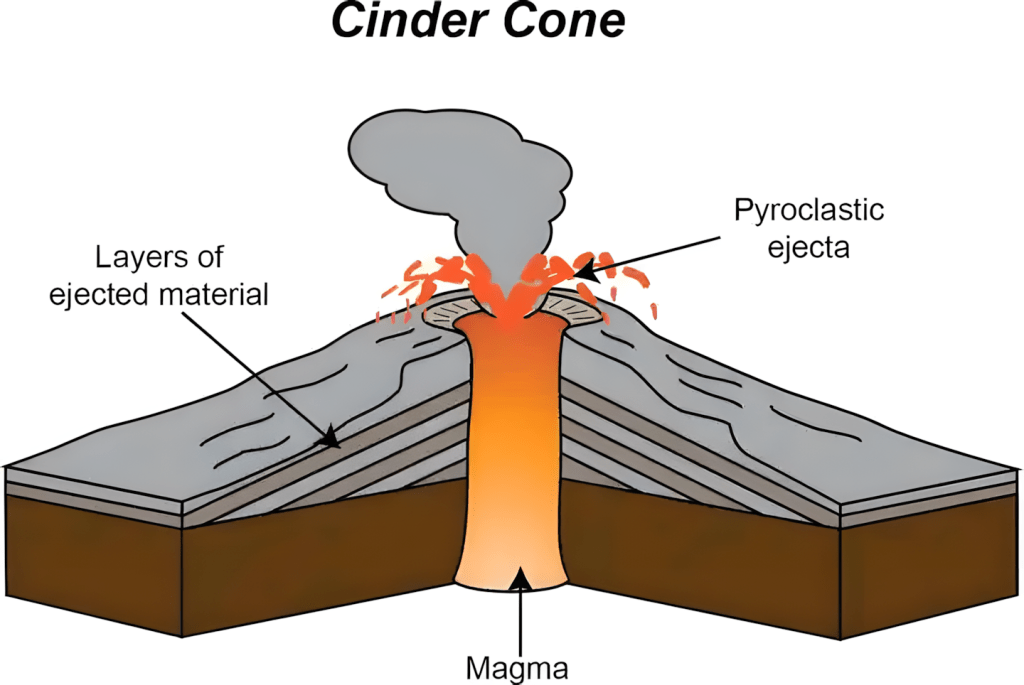
Repeated ejection and accumulation of spatters lead to the construction of a cone-shaped structure.
This process is most commonly observed in basaltic volcanic settings where the magma is fluid enough to allow blobs to be thrown out but viscous enough for the molten pieces to adhere upon landing.
Such activity is typical in volcanic rift zones and hotspot regions, like Iceland and Hawaii.
CHARACTERISTICS OF SPATTER CONES
Spatter cones display distinct physical and structural features:
Size: They are relatively small, usually a few meters to tens of meters high.
Shape: Cone-like or mound-shaped with steep sides that slope outward from the vent.
Composition: Primarily made of welded lava fragments, mostly basaltic in nature.
Texture: Rough, vesicular, and sometimes glassy due to rapid cooling of spatters.
Distribution: Often found in chains or clusters along fissure eruptions, forming spatter ramparts when aligned linearly.
화성암학: 스패터 콘(용암 덩어리로 이루어진 작은 화산 원뿔)
서론
스패터 콘은 화산 활동 중 용암 덩어리가 분출구 주변에 쌓여 형성되는 작은 화산 지형입니다.
스패터 콘은 화성암과 화산 구조의 기원, 분류 및 진화를 연구하는 화성암학의 한 분야입니다.
대형 성층화산이나 순상화산과는 달리 스패터 콘은 규모가 작지만 화산 폭발의 역학, 용암의 화학적 성질, 지표 지질학적 과정에 대한 귀중한 정보를 제공합니다.
형성 과정
스패터 콘은 주로 약한 강도에서 중간 강도의 폭발적인 화산 활동 중에 형성됩니다.
가스가 풍부한 마그마가 분출구를 통해 상승할 때, 용융된 용암 덩어리인 스패터로 부서집니다.
이러한 반용융 상태의 파편들은 뜨겁고 끈적한 상태로 분출구 주변에 떨어져 충돌 시 서로 붙어 굳어집니다.
스패터의 반복적인 분출과 축적은 원뿔 모양의 구조물을 형성하게 합니다.
이 현상은 마그마가 덩어리로 분출될 만큼 유동성이 있으면서도 착지 시 용융된 조각들이 서로 달라붙을 만큼 점성이 있는 현무암질 화산 환경에서 가장 흔하게 관찰됩니다.
이러한 활동은 아이슬란드와 하와이 같은 화산 열곡대와 열점 지역에서 흔히 나타납니다.
분출원뿔의 특징
분출원뿔은 다음과 같은 뚜렷한 물리적 및 구조적 특징을 보입니다.
크기: 비교적 작으며, 일반적으로 높이가 수 미터에서 수십 미터에 이릅니다.
모양: 원뿔 모양 또는 언덕 모양이며, 분출구에서 바깥쪽으로 경사가 가파른 측면을 지닙니다.
구성: 주로 용접된 용암 조각으로 이루어지며, 대부분 현무암질입니다.
질감: 거칠고 기포가 많으며, 분출물이 급속하게 냉각되어 유리질인 경우도 있습니다.
분포: 균열 분출을 따라 사슬 모양이나 군집 형태로 나타나는 경우가 많으며, 일렬로 늘어서면 분출 방벽을 형성합니다.
 HeriTrip.com
댓글 남기기