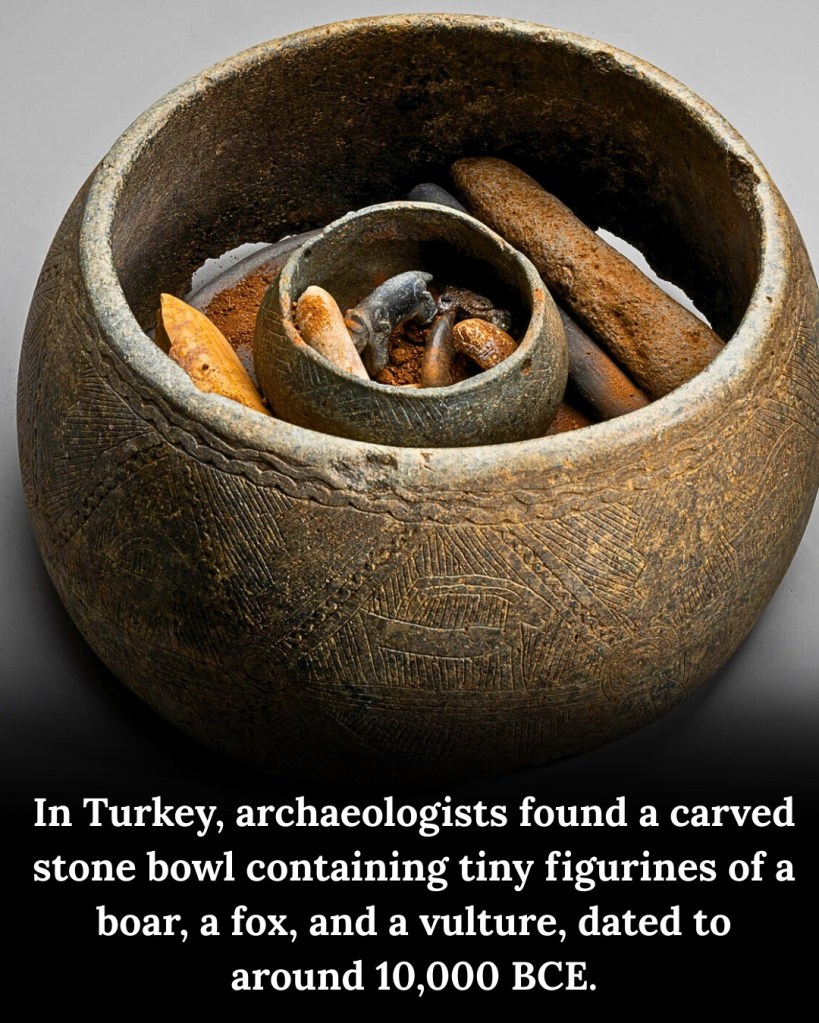
At Karahantepe, a neighbor of Göbeklitepe, excavations have revealed an object that may represent one of humanity’s earliest three-dimensional narratives. The artifact is an intricately decorated, bottomless stone bowl discovered in 2019 and dated to roughly 12,000 years ago.
Inside were carefully placed miniature stone figurines: a boar, a fox, and a vulture.
These animals are not random. Across early Neolithic sites in Upper Mesopotamia, each carries symbolic weight. Boars often appear in contexts linked to strength and danger, foxes to liminality and cunning, and vultures to death, exposure, and transformation. Their deliberate grouping within a single vessel suggests intention, sequence, and meaning—something closer to storytelling than ornament.
The bowl’s bottomless form hints that it was not made for storage or everyday use. Instead, it may have functioned in ritual performance, allowing objects or substances to pass through while the figures framed a symbolic scene. If so, the bowl was not just an object to be viewed, but a stage for action and memory.
Karahantepe has already transformed understanding of pre-agricultural societies by showing monumental architecture, complex iconography, and planned spaces created by hunter-gatherers. This small vessel adds another dimension: the possibility that people were arranging characters and conveying ideas in physical form thousands of years before writing.
Whether myth, ritual instruction, or cosmological reference, the bowl suggests that narrative thinking—expressed through sculpture rather than text—was already present at the dawn of settled human life.
괴베클리테페Göbeklitepe 인근 카라한테페Karahantepe 유적에서 발굴된 이 유물은 인류 최초의 3차원적 서사를 담고 있을 가능성이 있다.
2019년에 발견된 이 유물은 정교하게 장식한 바닥이 없는 돌그릇으로, 약 12,000년 전 것으로 추정된다.
그릇 안에는 멧돼지, 여우, 독수리 모양 작은 돌 조각상들이 정성스럽게 놓여 있었다.
이 동물들은 단순히 배치된 것이 아니다.
메소포타미아 북부 초기 신석기 시대 유적 곳곳에서 각각의 동물은 상징적인 의미를 지닌다.
멧돼지는 힘과 위험을, 여우는 경계와 교활함을, 독수리는 죽음, 노출, 변형을 상징하는 맥락에서 자주 등장한다.
하나의 그릇 안에 이 동물들이 의도적으로 함께 배치된 것은 장식이라기보다는 이야기를 전달하려는 의도와 순서, 의미를 시사한다.
바닥이 없는 형태는 이 그릇이 저장이나 일상생활용으로 만든 것이 아님을 암시한다.
오히려 의식에서 사용되었을 가능성이 높으며, 조각상들이 상징적인 장면을 구성하는 동안 물건이나 물질이 그릇을 통과하도록 했을 것으로 추측한다.
그렇다면 그 그릇은 단순히 감상하는 물건이 아니라 행동과 기억이 펼쳐지는 무대였던 것이다.
카라한테페 유적은 기념비적인 건축물, 복잡한 도상, 그리고 수렵채집인들이 만든 계획적인 공간들을 보여줌으로써 농경 이전 사회에 대한 이해를 이미 바꿔놓았다.
이 작은 그릇은 여기에 또 다른 차원을 더한다.
바로 사람들이 문자가 발명되기 수천 년 전에 이미 물리적인 형태로 형상을 배열하고 생각을 전달했을 가능성을 제시하는 것이다.
신화, 의례적 지시, 혹은 우주론적 의미를 담고 있든 간에, 이 용기는 문자가 아닌 조각을 통해 표현된 서사적 사고가 정착 생활의 여명기에 이미 존재했음을 시사한다.
 HeriTrip.com
댓글 남기기