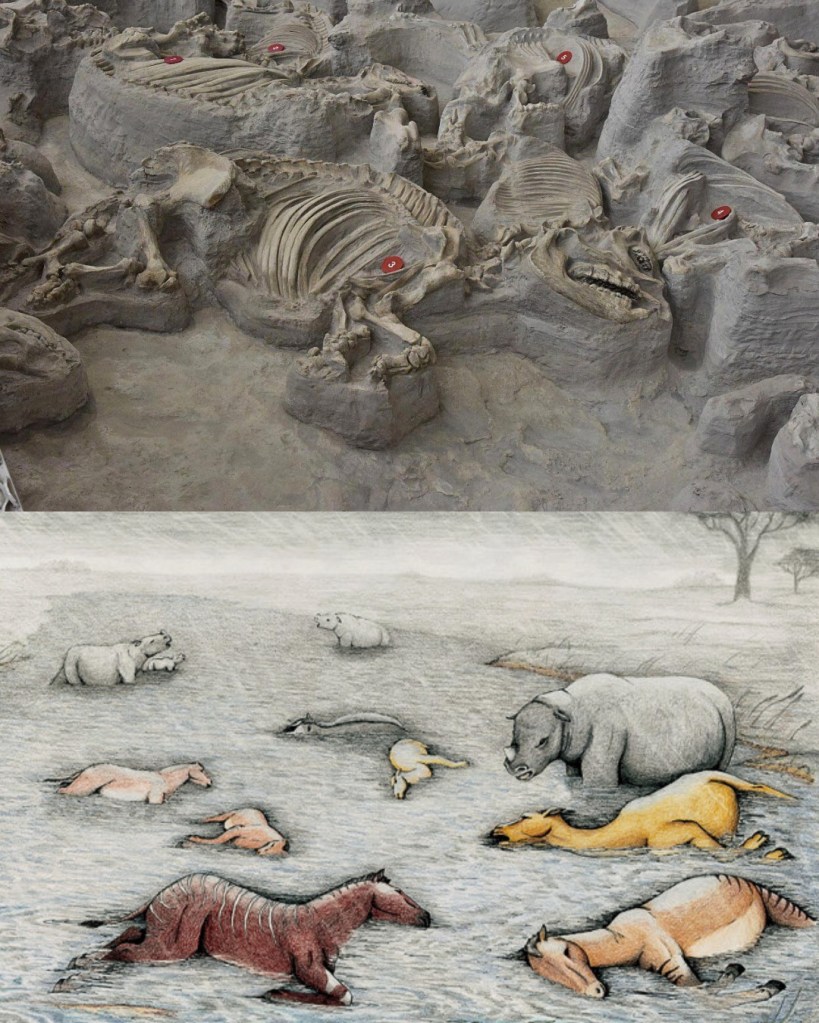
More than 12 million years ago, a volcanic eruption in what is now southeast Idaho spread ash across parts of present-day Nebraska. Over time, layers of fine ash settled across grasslands and watering holes, creating conditions that preserved the remains of numerous prehistoric animals.
Today, that site is known as Ashfall Fossil Beds State Historical Park in Royal, Nebraska. Excavations have revealed hundreds of well-preserved skeletons representing at least 12 species, including several types of horses, camels, and rhinoceroses. The fossils are displayed inside the Hubbard Rhino Barn, a protective structure that allows visitors to view the excavation area from elevated boardwalks while ongoing research continues.
The site was first identified in 1971 when a baby rhino skull was discovered in Antelope County. Continued study transformed the location into one of North America’s most significant Miocene fossil beds. In addition to large mammals, researchers have documented smaller finds, including fossilized tracks.
1200만 년도 더 전에, 현재 아이다호 주 남동부에 해당하는 지역에서 발생한 화산 폭발로 화산재가 오늘날 네브래스카 주 일부 지역에 퍼졌다.
시간이 흐르면서 미세한 화산재 층이 초원과 물웅덩이에 쌓이면서 수많은 선사시대 동물 화석이 보존될 환경이 조성되었다.
오늘날 이 지역은 네브래스카 주 로열Royal에 있는 애쉬폴 화석 지대 주립 역사 공원Ashfall Fossil Beds State Historical Park으로 알려져 있다.
발굴 조사를 통해 여러 종류 말, 낙타, 코뿔소를 포함해 최소 12종에 달하는 수백 개 잘 보존된 골격이 발견되었다.
화석은 허버드 코뿔소 헛간(Hubbard Rhino Barn) 내부에 전시되어 있으며, 이 보호 구조물을 통해 방문객들은 발굴 현장을 높은 나무 데크에서 관람할 수 있고, 그동안에도 연구가 계속 진행되고 있다.
이 지역은 1971년 앤텔롭 카운티에서 새끼 코뿔소 두개골이 발견되면서 처음 알려졌다.
지속적인 연구를 통해 이곳은 북미에서 가장 중요한 마이오세 화석 지대 중 하나로 자리매김했다.
연구자들은 대형 포유류 외에도 화석화한 발자국을 포함한 작은 화석들도 발견했다.
 HeriTrip.com
댓글 남기기