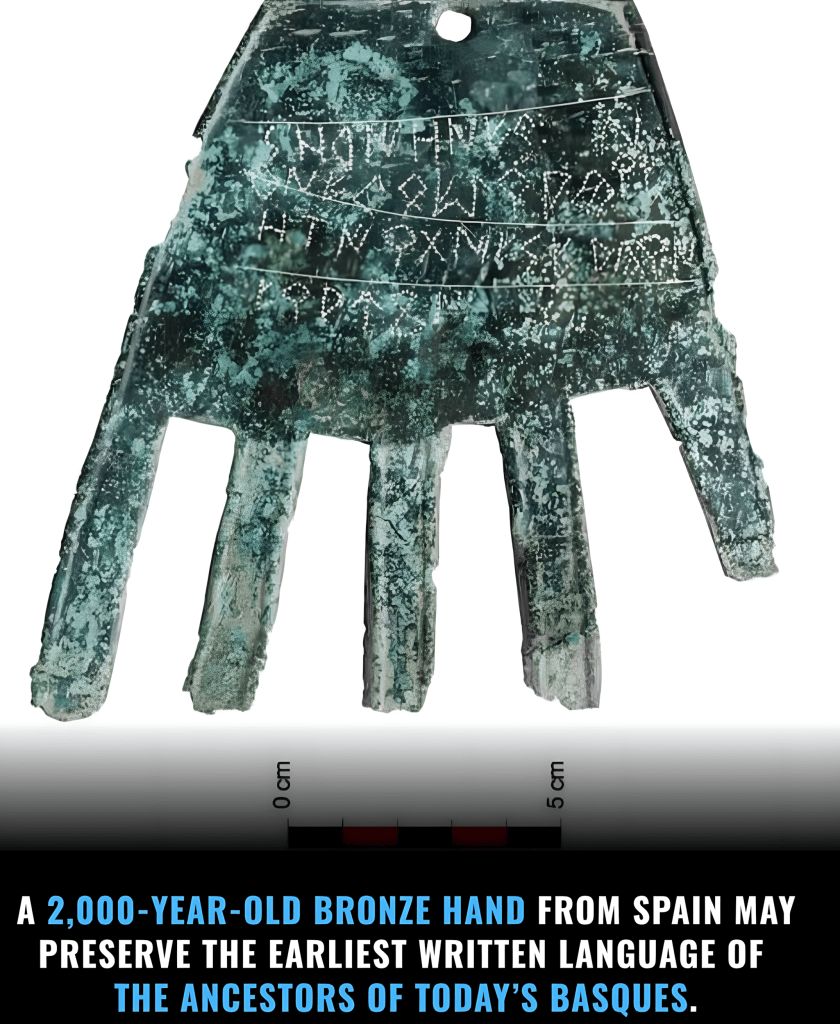
Archaeologists in northern Spain have uncovered a remarkable 2,000-year-old bronze hand engraved with letters that may represent an early form of the language spoken by the Vascones, ancestors of the modern-day Basque people.
The artifact, often referred to as the Irulegi Hand, was likely mounted at an entrance, possibly serving as a protective or symbolic object. Linguistic analysis suggests the inscription contains words related to good fortune, offering rare written evidence of a language long thought to be almost entirely unwritten in antiquity.
This discovery is especially significant because Basque is considered one of Europe’s oldest surviving languages, unrelated to Indo-European tongues. The bronze hand provides an extraordinary bridge between archaeology and linguistics, shedding new light on identity, communication, and cultural continuity in ancient Iberia.
스페인 북부에서 고고학자들이 2,000년 된 놀라운 청동 손 조각을 발굴했는데, 이 조각에는 오늘날 바스크인 조상인 바스코네스족이 사용한 언어 초기 형태를 나타내는 것으로 추정되는 글자가 새겨 있다.
이루레기 손Irulegi Hand으로 일컫는 이 유물은 입구에 설치되어 보호 또는 상징적인 역할을 했을 것으로 보인다.
언어 분석 결과, 새긴 글자는 행운과 관련된 단어들을 포함하는 것으로 나타났으며, 이는 고대에 거의 문자로 기록되지 않았다고 여긴 언어에 대한 드문 문자 증거다.
이 발견은 특히 중요한 의미를 지니는데, 바스크어는 인도유럽어족과는 관련이 없는 유럽에서 가장 오래된 언어 중 하나로 여겨지기 때문이다.
이 청동 손 조각은 고고학과 언어학을 잇는 특별한 다리 역할을 하며, 고대 이베리아 반도의 정체성, 소통, 그리고 문화적 연속성에 대한 새로운 통찰을 제공한다.
 HeriTrip.com
댓글 남기기