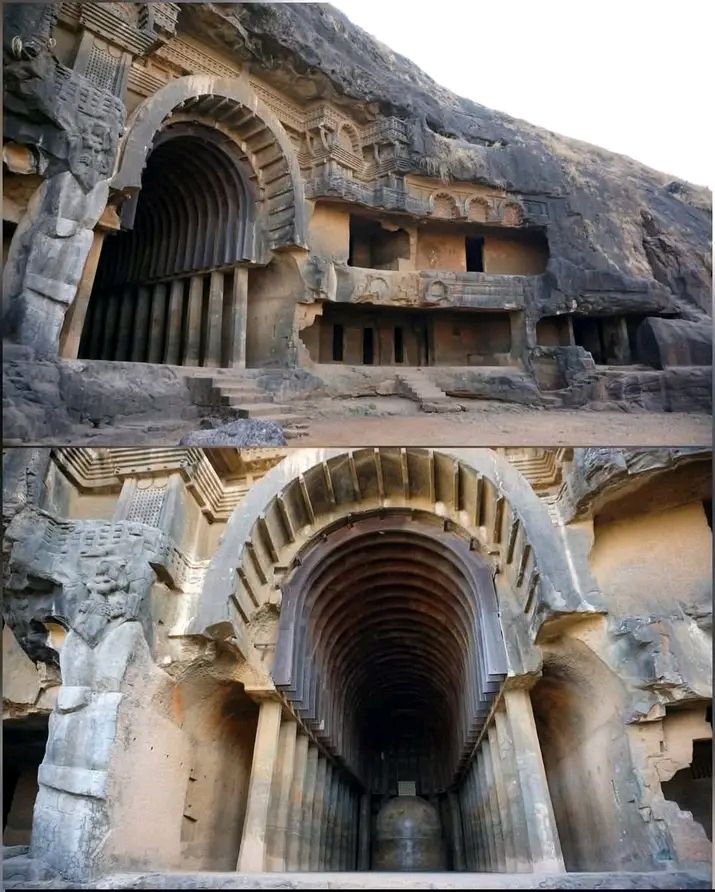
Carved into a sheer mountainside nearly 2,200 years ago, the Bhaja Caves in India raise a simple but staggering question: how did ancient craftsmen pull this off with nothing but hand tools?
These rock-cut monasteries feature perfectly rounded columns, vaulted ceilings, and a massive chaitya hall carved out of solid basalt — all done without metal drills, electric lighting, or modern surveying equipment. Every surface had to be shaped by hammer, chisel, and sheer endurance, yet the symmetry and acoustic design still hold up today.
We know Buddhist monks and artisans built them during the 2nd century BC, but the exact logistics — how many workers, how long it took, or the methods used to keep everything perfectly aligned in dark, confined rock — remain unclear. The caves stand as one of those ancient engineering achievements that remind us just how skilled early builders really was.
약 2,200년 전 인도 가파른 한 산비탈을 파고든 바자 석굴Bhaja Caves은 단순하지만 놀라운 질문을 던진다.
고대 장인들은 어떻게 오직 손 도구만으로 이 건축물을 만들어냈을까?
이 암석을 깎아 만든 수도원은 완벽하게 둥근 기둥, 아치형 천장, 그리고 단단한 현무암을 깎아 만든 거대한 차이티아 홀chaitya hall을 자랑한다.
이 모든 것은 금속 드릴, 전기 조명, 또는 현대적인 측량 장비 없이 만들었다.
모든 표면은 망치와 끌, 그리고 순전히 인내심으로 다듬어야 했지만, 그 대칭성과 음향 설계는 오늘날까지도 그대로 유지된다.
불교 승려와 장인들이 기원전 2세기에 이 석굴을 지었다는 사실은 알려졌지만 정확한 건축 방식, 즉 얼마나 많은 노동자가 동원되었는지, 얼마나 오랜 시간이 걸렸는지, 그리고 어둡고 좁은 암석 속에서 모든 것을 완벽하게 정렬하기 위해 어떤 방법을 사용했는지는 여전히 불분명하다.
이 석굴은 고대 건축가들의 뛰어난 기술력을 일깨워주는 고대 공학적 업적 중 하나다.
도대체 저런 바위 석굴은 왜 만들었을까? 나는 이 점이 궁금하다.
 HeriTrip.com
댓글 남기기